Minnesotans participate in high levels of physical activity,[147]
and many of these activities are outdoors. The strong interest of
Minnesotans in environmentalism has been attributed to the popularity of
these pursuits.[148]
In the warmer months, these activities often involve water. Weekend and longer trips to family cabins on Minnesota's numerous lakes are a way of life for many residents. Activities include water sports such as water skiing, which originated in the state,[149] boating, canoeing, and fishing. More than 36 percent of Minnesotans fish, second only to Alaska.[150]
Fishing does not cease when the lakes freeze; ice fishing has been around since the arrival of early Scandinavian immigrants.[151] Minnesotans have learned to embrace their long, harsh winters in ice sports such as skating, hockey, curling, and broomball, and snow sports such as cross-country skiing, alpine skiing, snowshoeing, and snowmobiling.[152] Minnesota is the only U.S. state where bandy is played.[153]
State and national forests and the seventy-two state parks are used year-round for hunting, camping, and hiking. There are almost 20,000 miles (32,000 km) of snowmobile trails statewide.[154] Minnesota has more miles of bike trails than any other state,[155] and a growing network of hiking trails, including the 235-mile (378 km) Superior Hiking Trail in the northeast.[156] Many hiking and bike trails are used for cross-country skiing during the winter.
Thursday, March 30, 2017

Sports, recreation and tourism
Minnesota has a very active program of organized amateur and
professional sports. Tourism has become an important industry,
especially in the Lake region. In the North Country, what had been an
industrial area focused on mining and timber has largely been
transformed into a vacation destination. Popular interest in the
environment and environmentalism, added to traditional interests in hunting and fishing, has attracted a large urban audience within driving range.[140]
Minnesota has professional men's teams in all major sports. Minnesota Vikings play in the National Football League since 1961. The Hubert H. Humphrey Metrodome hosted the team from 1982 to 2013 season; it has been torn down and U.S. Bank Stadium now stands in its place.
The Minnesota Twins play in the Major League Baseball since 1961, having won the 1987 and 1991 World Series. The team plays at Target Field since 2010. The Minneapolis Lakers of the National Basketball Association played in the Minneapolis Auditorium from 1947 to 1960, after which they relocated to Los Angeles. The Minnesota Timberwolves joined the NBA in 1989, and play in the Target Center since 1990.
The National Hockey League's Minnesota Wild play in St. Paul's Xcel Energy Center and reached 300 consecutive sold-out games on January 16, 2008.[141] Previously, the Minnesota North Stars competed in NHL from 1967 to 1993, which played the 1981 and 1991 Stanley Cup Finals.
Minnesota also has minor-league professional sports. NASL Minnesota United FC replaced the Minnesota Thunder in 2010 and plays at the National Sports Center in Blaine. They will eventually join Major League Soccer in 2017 or 2018.[142] The Minnesota Swarm play at the Xcel Energy Center and play in the NLL (National Lacrosse League). Minor league baseball is represented both by major league-sponsored teams and independent teams such as the St. Paul Saints, who play at CHS Field in St. Paul.
Professional women's sports include the Minnesota Lynx of the Women's National Basketball Association, winners of the 2011, 2013, and 2015 WNBA Championships, the Minnesota Lightning of the United Soccer Leagues W-League, the Minnesota Vixen of the Independent Women's Football League, the Minnesota Valkyrie of the Legends Football League, and the Minnesota Whitecaps of the National Women's Hockey League.
The Twin Cities campus of the University of Minnesota is a National Collegiate Athletic Association (NCAA) Division I school competing in the Big Ten Conference. Four additional schools in the state compete in NCAA Division I ice hockey: the University of Minnesota Duluth; Minnesota State University, Mankato; St. Cloud State University and Bemidji State University. There are nine NCAA Division II colleges in the Northern Sun Intercollegiate Conference, and nineteen NCAA Division III colleges in the Minnesota Intercollegiate Athletic Conference and Upper Midwest Athletic Conference.[143][144]
The Hazeltine National Golf Club has hosted the U.S. Open, U.S. Women's Open, U.S. Senior Open and PGA Championship. The course will also host the Ryder Cup in the fall of 2016, when it will become one of two courses in the U.S. to host all major golf competitions.[145]
Interlachen Country Club has hosted the U.S. Open, U.S. Women's Open, and Solheim Cup.
Winter Olympic Games medallists from the state include twelve of the twenty members of the gold medal 1980 ice hockey team (coached by Minnesota native Herb Brooks) and the bronze medallist U.S. men's curling team in the 2006 Winter Olympics. Swimmer Tom Malchow won an Olympic gold medal in the 2000 Summer games and a silver medal in 1996.
Grandma's Marathon is run every summer along the scenic North Shore of Lake Superior, and the Twin Cities Marathon winds around lakes and the Mississippi River during the peak of the fall color season. Farther north, Eveleth is the location of the United States Hockey Hall of Fame.


Minnesotans participate in high levels of physical activity,[147]
and many of these activities are outdoors. The strong interest of
Minnesotans in environmentalism has been attributed to the popularity of
these pursuits.[148]
In the warmer months, these activities often involve water. Weekend and longer trips to family cabins on Minnesota's numerous lakes are a way of life for many residents. Activities include water sports such as water skiing, which originated in the state,[149] boating, canoeing, and fishing. More than 36 percent of Minnesotans fish, second only to Alaska.[150]
Fishing does not cease when the lakes freeze; ice fishing has been around since the arrival of early Scandinavian immigrants.[151] Minnesotans have learned to embrace their long, harsh winters in ice sports such as skating, hockey, curling, and broomball, and snow sports such as cross-country skiing, alpine skiing, snowshoeing, and snowmobiling.[152] Minnesota is the only U.S. state where bandy is played.[153]
State and national forests and the seventy-two state parks are used year-round for hunting, camping, and hiking. There are almost 20,000 miles (32,000 km) of snowmobile trails statewide.[154] Minnesota has more miles of bike trails than any other state,[155] and a growing network of hiking trails, including the 235-mile (378 km) Superior Hiking Trail in the northeast.[156] Many hiking and bike trails are used for cross-country skiing during the winter.
Organized sports
Main article: Sports in Minnesota

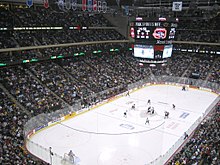
The University of North Dakota and St. Cloud State University during the WCHA Final Five at the Xcel Energy Center.
The Minnesota Twins play in the Major League Baseball since 1961, having won the 1987 and 1991 World Series. The team plays at Target Field since 2010. The Minneapolis Lakers of the National Basketball Association played in the Minneapolis Auditorium from 1947 to 1960, after which they relocated to Los Angeles. The Minnesota Timberwolves joined the NBA in 1989, and play in the Target Center since 1990.
The National Hockey League's Minnesota Wild play in St. Paul's Xcel Energy Center and reached 300 consecutive sold-out games on January 16, 2008.[141] Previously, the Minnesota North Stars competed in NHL from 1967 to 1993, which played the 1981 and 1991 Stanley Cup Finals.
Minnesota also has minor-league professional sports. NASL Minnesota United FC replaced the Minnesota Thunder in 2010 and plays at the National Sports Center in Blaine. They will eventually join Major League Soccer in 2017 or 2018.[142] The Minnesota Swarm play at the Xcel Energy Center and play in the NLL (National Lacrosse League). Minor league baseball is represented both by major league-sponsored teams and independent teams such as the St. Paul Saints, who play at CHS Field in St. Paul.
Professional women's sports include the Minnesota Lynx of the Women's National Basketball Association, winners of the 2011, 2013, and 2015 WNBA Championships, the Minnesota Lightning of the United Soccer Leagues W-League, the Minnesota Vixen of the Independent Women's Football League, the Minnesota Valkyrie of the Legends Football League, and the Minnesota Whitecaps of the National Women's Hockey League.
The Twin Cities campus of the University of Minnesota is a National Collegiate Athletic Association (NCAA) Division I school competing in the Big Ten Conference. Four additional schools in the state compete in NCAA Division I ice hockey: the University of Minnesota Duluth; Minnesota State University, Mankato; St. Cloud State University and Bemidji State University. There are nine NCAA Division II colleges in the Northern Sun Intercollegiate Conference, and nineteen NCAA Division III colleges in the Minnesota Intercollegiate Athletic Conference and Upper Midwest Athletic Conference.[143][144]
The Hazeltine National Golf Club has hosted the U.S. Open, U.S. Women's Open, U.S. Senior Open and PGA Championship. The course will also host the Ryder Cup in the fall of 2016, when it will become one of two courses in the U.S. to host all major golf competitions.[145]
Interlachen Country Club has hosted the U.S. Open, U.S. Women's Open, and Solheim Cup.
Winter Olympic Games medallists from the state include twelve of the twenty members of the gold medal 1980 ice hockey team (coached by Minnesota native Herb Brooks) and the bronze medallist U.S. men's curling team in the 2006 Winter Olympics. Swimmer Tom Malchow won an Olympic gold medal in the 2000 Summer games and a silver medal in 1996.
Grandma's Marathon is run every summer along the scenic North Shore of Lake Superior, and the Twin Cities Marathon winds around lakes and the Mississippi River during the peak of the fall color season. Farther north, Eveleth is the location of the United States Hockey Hall of Fame.
Outdoor recreation

Fishing in Lake Calhoun in Minneapolis

The common loon's distinctive cry is heard during the summer months on lakes throughout the state.[146]
In the warmer months, these activities often involve water. Weekend and longer trips to family cabins on Minnesota's numerous lakes are a way of life for many residents. Activities include water sports such as water skiing, which originated in the state,[149] boating, canoeing, and fishing. More than 36 percent of Minnesotans fish, second only to Alaska.[150]
Fishing does not cease when the lakes freeze; ice fishing has been around since the arrival of early Scandinavian immigrants.[151] Minnesotans have learned to embrace their long, harsh winters in ice sports such as skating, hockey, curling, and broomball, and snow sports such as cross-country skiing, alpine skiing, snowshoeing, and snowmobiling.[152] Minnesota is the only U.S. state where bandy is played.[153]
State and national forests and the seventy-two state parks are used year-round for hunting, camping, and hiking. There are almost 20,000 miles (32,000 km) of snowmobile trails statewide.[154] Minnesota has more miles of bike trails than any other state,[155] and a growing network of hiking trails, including the 235-mile (378 km) Superior Hiking Trail in the northeast.[156] Many hiking and bike trails are used for cross-country skiing during the winter.
Media
The Twin Cities area is the fifteenth largest media market in the United States as ranked by Nielsen Media Research. The state's other top markets are Fargo–Moorhead (118th nationally), Duluth–Superior (137th), Rochester–Mason City–Austin (152nd), and Mankato (200th).[135]
Broadcast television in Minnesota and the Upper Midwest started on April 27, 1948, when KSTP-TV began broadcasting.[136] Hubbard Broadcasting, which owns KSTP, is now the only locally owned television company in Minnesota. There are currently 39 analog broadcast stations and 23 digital channels broadcast over Minnesota.
The four largest daily newspapers are the Star Tribune in Minneapolis, the Pioneer Press in Saint Paul, the Duluth News Tribune in Duluth and the Post-Bulletin in Rochester. The Minnesota Daily is the largest student-run newspaper in the U.S.[137] Sites offering daily news on the Web include The UpTake, MinnPost, the Twin Cities Daily Planet, business news site Finance and Commerce and Washington D.C.-based Minnesota Independent. Weeklies including City Pages and monthly publications such as Minnesota Monthly are available.
Two of the largest public radio networks, Minnesota Public Radio (MPR) and Public Radio International (PRI), are based in the state. MPR has the largest audience of any regional public radio network in the nation, broadcasting on 37 radio stations.[138] PRI weekly provides more than 400 hours of programming to almost 800 affiliates.[139] The state's oldest radio station, KUOM-AM, was launched in 1922 and is among the 10-oldest radio stations in the United States. The University of Minnesota-owned station is still on the air, and since 1993 broadcasts a college rock format.
Broadcast television in Minnesota and the Upper Midwest started on April 27, 1948, when KSTP-TV began broadcasting.[136] Hubbard Broadcasting, which owns KSTP, is now the only locally owned television company in Minnesota. There are currently 39 analog broadcast stations and 23 digital channels broadcast over Minnesota.
The four largest daily newspapers are the Star Tribune in Minneapolis, the Pioneer Press in Saint Paul, the Duluth News Tribune in Duluth and the Post-Bulletin in Rochester. The Minnesota Daily is the largest student-run newspaper in the U.S.[137] Sites offering daily news on the Web include The UpTake, MinnPost, the Twin Cities Daily Planet, business news site Finance and Commerce and Washington D.C.-based Minnesota Independent. Weeklies including City Pages and monthly publications such as Minnesota Monthly are available.
Two of the largest public radio networks, Minnesota Public Radio (MPR) and Public Radio International (PRI), are based in the state. MPR has the largest audience of any regional public radio network in the nation, broadcasting on 37 radio stations.[138] PRI weekly provides more than 400 hours of programming to almost 800 affiliates.[139] The state's oldest radio station, KUOM-AM, was launched in 1922 and is among the 10-oldest radio stations in the United States. The University of Minnesota-owned station is still on the air, and since 1993 broadcasts a college rock format.
Politics
Main article: Politics of Minnesota
See also: List of political parties in Minnesota, United States congressional delegations from Minnesota, Minnesota's congressional districts, and Political party strength in Minnesota
| Year | Office | GOP | DFL | Others |
|---|---|---|---|---|
| 2014 | Governor | 44.5% | 50.1% | 5.4% |
| Senator | 42.9% | 53.2% | 3.9% | |
| 2012 | President | 45.1% | 52.8% | 2.1% |
| Senator | 30.6% | 65.3% | 4.1% | |
| 2010 | Governor | 43.2% | 43.7% | 13.1% |
| 2008 | President | 43.8% | 54.1% | 2.1% |
| Senator | 42.0% | 42.0% | 16.0% | |
| 2006 | Governor | 46.7% | 45.7% | 7.6% |
| Senator | 37.9% | 58.1% | 4.0% | |
| 2004 | President | 47.6% | 51.1% | 1.3% |
| 2002 | Governor | 44.4% | 33.5% | 22.1% |
| Senator | 49.5% | 47.3% | 1.0% | |
| 2000 | President | 45.5% | 47.9% | 6.6% |
| Senator | 43.3% | 48.8% | 7.9% | |
| 1998 | Governor | 34.3% | 28.1% | 37.6% |
| 1996 | President | 35.0% | 51.1% | 13.9% |
| Senator | 41.3% | 50.3% | 8.4% | |
| 1994 | Governor | 63.3% | 34.1% | 2.6% |
| Senator | 49.1% | 44.1% | 6.8% | |
| 1992 | President | 31.9% | 43.5% | 24.6% |
Hubert Humphrey brought national attention to the state with his address at the 1948 Democratic National Convention. Minnesotans have consistently cast their Electoral College votes for Democratic presidential candidates since 1976, longer than any other state. Minnesota is the only state in the nation that did not vote for Ronald Reagan in either of his presidential runs. Minnesota has gone to the Democratic Party in every presidential election since 1960, with the exception of 1972, when it was carried by Richard Nixon and the Republican Party.
Both the Democratic and Republican parties have major party status in Minnesota, but its state-level "Democratic" party is actually a separate party, officially known as the Minnesota Democratic-Farmer-Labor Party (DFL). It was formed out of a 1944 alliance of the Minnesota Democratic and Farmer-Labor parties.
The state has had active third party movements. The Reform Party, now the Independence Party, was able to elect former mayor of Brooklyn Park and professional wrestler Jesse Ventura to the governorship in 1998. The Independence Party has received enough support to keep major party status. The Green Party, while no longer having major party status, has a large presence in municipal government,[131] notably in Minneapolis and Duluth, where it competes directly with the DFL party for local offices. Official "Major party" status in Minnesota (which grants state funding for elections) is reserved to parties whose candidates receive five percent or more of the vote in any statewide election (e.g., Governor, Secretary of State, U.S. President).
The state's U.S. Senate seats have generally been split since the early 1990s, and in the 108th and 109th Congresses, Minnesota's congressional delegation was split, with four representatives and one senator from each party. In the 2006 midterm election, Democrats were elected to all state offices except for governor and lieutenant governor, where Republicans Tim Pawlenty and Carol Molnau narrowly won reelection. The DFL posted double-digit gains in both houses of the legislature, elected Amy Klobuchar to the U.S. Senate, and increased the party's U.S. House caucus by one. Keith Ellison (DFL) was elected as the first African American U.S. Representative from Minnesota, as well as the first Muslim elected to Congress nationwide.[132] In 2008, DFLer and former comedian and radio talk show host Al Franken beat incumbent Republican Norm Coleman in the United States Senate race by 312 votes out of 3 million cast.
In the election of 2010, Republicans took control of both chambers of the Minnesota legislature for the first time in 38 years and, with Mark Dayton's election, the DFL party took the governor's office for the first time in 20 years. Two years later, the DFL regained control of both houses, and with Governor Dayton in office, the party had same-party control of both the legislative and executive branches for the first time since 1990. Two years later, the Republicans regained control of the Minnesota House in the 2014 election,[133] and in 2016, the GOP also regained control of the State Senate.[134]
Regional
In addition to the city and county levels of government found in the
United States, Minnesota has other entities that provide governmental
oversight and planning. Some actions in the Twin Cities metropolitan
area are coordinated by the Metropolitan Council, and many lakes and rivers are overseen by watershed districts and soil and water conservation districts.
Federal court cases are heard in the United States District Court for the District of Minnesota, which holds court in Minneapolis, St. Paul, Duluth, and Fergus Falls. Appeals are heard by the Eighth Circuit Court of Appeals, which is based in St. Louis, Missouri and routinely also hears cases in St. Paul.
Four Dakota Mdewakanton communities:
Federal
Minnesota's United States senators are Democrat Amy Klobuchar and Democrat Al Franken. The outcome of the 2008 U.S. Senate election in Minnesota was contested until June 30 the next year; when the Minnesota Supreme Court ruled in favor of Franken, Republican Norm Coleman conceded defeat, and the vacant seat was filled by Franken.[124] The state has eight congressional districts; they are represented by Tim Walz (1st district; DFL), Jason Lewis (2nd; R), Erik Paulsen (3rd; R), Betty McCollum (4th; DFL), Keith Ellison (5th; DFL), Tom Emmer (6th; R), Collin Peterson (7th; DFL), and Rick Nolan (8th; DFL).Federal court cases are heard in the United States District Court for the District of Minnesota, which holds court in Minneapolis, St. Paul, Duluth, and Fergus Falls. Appeals are heard by the Eighth Circuit Court of Appeals, which is based in St. Louis, Missouri and routinely also hears cases in St. Paul.
Tribal
The State of Minnesota was created by the U.S. out of the homelands of the Dakota and Anishinaabe native peoples. Today the remaining native governments are divided into 11 semi-autonomous reservations that negotiate with the US and the state on a peer nation-to-nation basis:Four Dakota Mdewakanton communities:
- Prairie Island Indian Community
- Shakopee Mdewakanton Sioux Community
- Lower Sioux Indian Reservation
- Upper Sioux Community – Pejuhutazizi Oyate
- Bois Forte Band of Chippewa
- Fond du Lac Band of Lake Superior Chippewa
- Grand Portage Band of Chippewa
- Leech Lake Band of Ojibwe
- Mille Lacs Band of Ojibwe
- White Earth Band of Ojibwe
- Red Lake Band of Chippewa
Law and government
As with the federal government of the United States, power in
Minnesota is divided into three branches: executive, legislative, and
judicial.[121]
 The executive branch is headed by the governor. Governor Mark Dayton, DFL (Democratic Farmer Labor), took office on January 3, 2011, to become the first DFL governor to hold the seat in two decades. The governor has a cabinet
consisting of the leaders of various state government agencies, called
commissioners. The other elected constitutional offices are secretary of state, attorney general, and state auditor.
The executive branch is headed by the governor. Governor Mark Dayton, DFL (Democratic Farmer Labor), took office on January 3, 2011, to become the first DFL governor to hold the seat in two decades. The governor has a cabinet
consisting of the leaders of various state government agencies, called
commissioners. The other elected constitutional offices are secretary of state, attorney general, and state auditor.
 The Minnesota Legislature is a bicameral body consisting of the Senate and the House of Representatives.
The state has sixty-seven districts, each covering about sixty thousand
people. Each district has one senator and two representatives (each
district being divided into A and B sections). Senators serve for four years and representatives for two years. In the November 2010 election, the Minnesota Republican Party gained twenty-five house seats, giving them control of the House of Representatives by a 72–62 margin.[122]
The 2010 election also saw Minnesota voters elect a Republican majority
in the Senate for the first time since 1972. In 2012, the Democrats
regained the House of Representatives by a margin of 73–61, picking up
11 seats; the Democrats also regained the Minnesota Senate.
The Minnesota Legislature is a bicameral body consisting of the Senate and the House of Representatives.
The state has sixty-seven districts, each covering about sixty thousand
people. Each district has one senator and two representatives (each
district being divided into A and B sections). Senators serve for four years and representatives for two years. In the November 2010 election, the Minnesota Republican Party gained twenty-five house seats, giving them control of the House of Representatives by a 72–62 margin.[122]
The 2010 election also saw Minnesota voters elect a Republican majority
in the Senate for the first time since 1972. In 2012, the Democrats
regained the House of Representatives by a margin of 73–61, picking up
11 seats; the Democrats also regained the Minnesota Senate.
Two specialized courts within administrative agencies have been established: the workers' compensation court of appeals, and the tax court, which deals with non-criminal tax cases.
Executive
Main article: Governor of Minnesota

Governor Mark Dayton
Legislature
Main article: Minnesota Legislature

The Minnesota State Capitol in Saint Paul, designed by Cass Gilbert.
Judiciary
Minnesota's court system has three levels. Most cases start in the district courts, which are courts of general jurisdiction. There are 279 district court judgeships in ten judicial districts. Appeals from the trial courts and challenges to certain governmental decisions are heard by the Minnesota Court of Appeals, consisting of nineteen judges who typically sit in three-judge panels. The seven-justice Minnesota Supreme Court hears all appeals from the tax court, the workers' compensation court of appeals, first-degree murder convictions, and discretionary appeals from the court of appeals; it also has original jurisdiction over election disputes.[123]Two specialized courts within administrative agencies have been established: the workers' compensation court of appeals, and the tax court, which deals with non-criminal tax cases.
Transportation
Main article: Transportation in Minnesota

The Aerial Lift Bridge at Duluth

A Metro Blue Line vehicle in Minneapolis
Amtrak's daily Empire Builder (Chicago–Seattle/Portland) train runs through Minnesota, calling at the Saint Paul Union Depot and five other stations.[120] Intercity bus providers include Jefferson Lines, Greyhound, and Megabus. Local public transit is provided by bus networks in the larger cities and by two rail services. The Northstar Line commuter rail service runs from Big Lake to the Target Field station in downtown Minneapolis. From there, light rail runs to Saint Paul Union Depot on the Green Line, and to the MSP airport and the Mall of America via the Blue Line.
Education
Main article: Education in Minnesota
See also: List of colleges and universities in Minnesota, List of high schools in Minnesota, and List of school districts in Minnesota

The Richardsonian Romanesque Pillsbury Hall (1889) is one of the oldest buildings on the University of Minnesota Minneapolis campus.
The state supports a network of public universities and colleges, including 32 institutions in the Minnesota State Colleges and Universities System, and five major campuses of the University of Minnesota. It is also home to more than 20 private colleges and universities, six of which rank among the nation's top 100 liberal arts colleges, according to U.S. News & World Report.[114]
Health
Minnesotans have low rates of premature death, infant mortality, cardiovascular disease, and occupational fatalities.[95][96] They have long life expectancies,[97] and high rates of health insurance and regular exercise.[95][98][99]
These and other measures have led two groups to rank Minnesota as the
healthiest state in the nation; however, in one of these rankings,
Minnesota descended from first to sixth in the nation between 2005 and
2009 because of low levels of public health funding and the prevalence
of binge drinking.[95][100]
On October 1, 2007, Minnesota became the 17th state to enact the Freedom to Breathe Act, a statewide smoking ban in restaurants and bars.[101]
Medical care in the state is provided by a comprehensive network of hospitals and clinics headed by two institutions with international reputations. The University of Minnesota Medical School is a high-rated teaching institution that has made a number of breakthroughs in treatment, and its research activities contribute significantly to the state's growing biotechnology industry.[102] The Mayo Clinic, a world-renowned hospital based in Rochester, was founded by William Worrall Mayo, an immigrant from England.[103][104]
U.S. News and World Report's 2014–2015 survey ranked 4,743 hospitals in the United States in 16 specialized fields of care, and placed the Mayo Clinic in the top four in all fields except psychiatry, where it ranked seventh. The hospital ranked #1 in eight fields and #2 in three others.[105] The Mayo Clinic and the University of Minnesota are partners in the Minnesota Partnership for Biotechnology and Medical Genomics, a state-funded program that conducts research into cancer, Alzheimer's disease, heart health, obesity, and other areas.[106]
On October 1, 2007, Minnesota became the 17th state to enact the Freedom to Breathe Act, a statewide smoking ban in restaurants and bars.[101]
Medical care in the state is provided by a comprehensive network of hospitals and clinics headed by two institutions with international reputations. The University of Minnesota Medical School is a high-rated teaching institution that has made a number of breakthroughs in treatment, and its research activities contribute significantly to the state's growing biotechnology industry.[102] The Mayo Clinic, a world-renowned hospital based in Rochester, was founded by William Worrall Mayo, an immigrant from England.[103][104]
U.S. News and World Report's 2014–2015 survey ranked 4,743 hospitals in the United States in 16 specialized fields of care, and placed the Mayo Clinic in the top four in all fields except psychiatry, where it ranked seventh. The hospital ranked #1 in eight fields and #2 in three others.[105] The Mayo Clinic and the University of Minnesota are partners in the Minnesota Partnership for Biotechnology and Medical Genomics, a state-funded program that conducts research into cancer, Alzheimer's disease, heart health, obesity, and other areas.[106]
Popular culture

A youth fiddle performance at the Minnesota State Fair
The Minnesota State Fair, advertised as The Great Minnesota Get-Together, is an icon of state culture. In a state of 5.4 million people, there were over 1.8 million visitors to the fair in 2014, setting a new attendance record.[94] The fair covers the variety of Minnesotan life, including fine art, science, agriculture, food preparation, 4-H displays, music, the midway, and corporate merchandising. It is known for its displays of seed art, butter sculptures of dairy princesses, the birthing barn, and the "fattest pig" competition. One can also find dozens of varieties of food on a stick, such as Pronto Pups, cheese curds, and deep-fried candy bars. On a smaller scale, many of these attractions are offered at numerous county fairs.
Other large annual festivals include the Saint Paul Winter Carnival, the Minnesota Renaissance Festival, Minneapolis' Aquatennial and Mill City Music Festival, Moondance Jam in Walker, Sonshine Christian music festival in Willmar, the Judy Garland Festival in Grand Rapids, the Eelpout Festival on Leech Lake, and the WE Fest in Detroit Lakes.
Subscribe to:
Posts (Atom)